| 价格 | ¥4800.00 |
| 品牌 | NewEast Biosciences  |
| 产地 | 中国 武汉 |
| 货号 | 26910 |
| 规格 | 30μl |
| 说明书 | 说明书下载 |
Active Rheb GTP [26910]
[30 µL]
| Catalog Number: 26910 |
| Gene Symbol: RHEB |
| Description: Anti Active Rheb Mouse Monoclonal Antibody |
| Background: Small GTPases are a super-family of cellular signaling regulators. Rheb is a member of the Ras-superfamily GTPases. Rheb has been shown to interact with C-Raf, Mammalian target of rapamycin (mTOR), TSC2, Ataxia telangiectasia mutated (ATM), KIAA1303 and Ataxia telangiectasia and Rad3 related (ATR). |
| Immunogen: Recombinant full length protein of active Rheb. |
| Applications: IP, IHC |
| Recommended Dilutions: 1 μg for 1~2 mg total cellular proteins for IP 1:100 dilution for IHC |
| Concentration: 1 mg/ml |
| Host: mouse |
| Format: Liquid |
| Clonality: Monoclonal |
| Isotype: IgM |
| Purity: Purified from ascites |
| Storage buffer: |
| Preservative: no |
| Constituents: PBS (without Mg2+ and Ca2+), pH 7.4, 150 mM NaCl, 50% glycerol |
| Species Reactivity: Anti active Rheb antibody recognizes active Rheb of vertebrates. |
| Storage Conditions: Store at -20°C. Avoid freeze / thaw cycles |
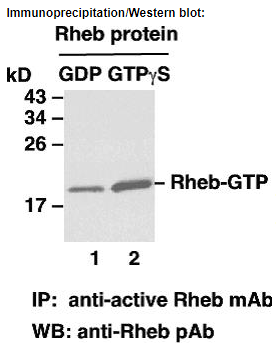
| Immunoprecipitation/Western blot: |
 |
Rheb activation assay. Purified Rheb proteins were immunoprecipitated after treated with GDP (lane 1) or GTPγS (lane 2). Immunoprecipitation was done with the anti active Rheb monoclonal antibody (Cat. No. 26910). Immunoblot was with an anti Rheb rabbit polyclonal antibody (Cat. No. 21098). |
| Related Products | |||
| Catalog# | Name | Size | Price |
| 26910 | Active RheB GTP Monoclonal Antibody | 30 μL | ¥4800 |
| 81201 | RheB Activation Assay Kit | 20 assays | ¥6800 |
| 26015 | Anti RheB Mouse Monoclonal Antibody | 100 μL | ¥2800 |
| 21098 | Anti RheB Rabbit Polyclonal Antibody | 100 μL | ¥2600 |
| Publications: |
| 1. Inducible Nitric Oxide Synthase Drives mTOR Pathway Activation and Proliferation of Human Melanoma by Reversible Nitrosylation of TSC2 Cancer Res. 2014 Feb 15;74(4):1067-78 |
| 2. SynGAP Regulates Protein Synthesis and Homeostatic Synaptic Plasticity in Developing Cortical Networks PLoS One. 2013 Dec 31;8(12):e83941 |
影响因子:Brain IF=14.5
应用范围:IP-WB
种属:Mouse
影响因子:EMBO Reports IF=7.7
应用范围:IP-WB
种属:Human
影响因子:Oncogene IF=9.8
应用范围:IP-WB
种属:Human
影响因子:Journal of Immunology IF=4.4
应用范围:FC
种属:Mouse